How Daily Matcha Supports Gut Health (And Why Quality Matters)


Matcha tea has taken over our local cafés, and is currently marketed as something that “can support our gut microbiome“. But this claim is often oversimplified.
At ThessMatcha, we recently examined this in our published paper, exploring how matcha’s composition and quality influence its interaction with the gut microbiome (and whether matcha tea indeed promotes our gut health).
Why Matcha Quality Changes Its Gut Effects?
Not all matcha delivers the same biological effect-and this comes down to composition.
As highlighted in our paper, matcha quality is primarily defined by its sensory profile, which reflects the balance between catechins and amino acids. Also, different grades of matcha vary substantially in their catechin and specifically EGCG content, the main compounds posing effects in our gut microbiome.
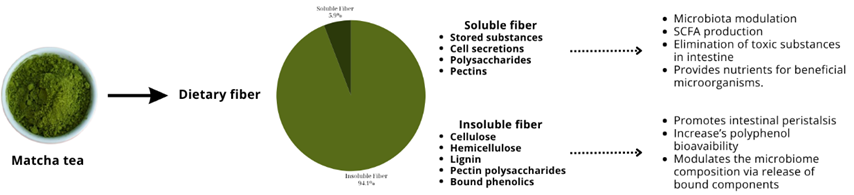
Importantly, matcha is consumed as a whole-leaf powder, not as an infusion. As a result, both water-soluble and water-insoluble compounds are ingested, including catechins and dietary fiber. In fact, approximately 60-70% of matcha nutrients are water-insoluble, including fiber-bound bioactive compounds that are released during digestion and may exert biological effects in the gut. Also, matcha has been associated with greater bioavailability of catechins compared to green tea infusions, increasing the amount of bioactive compounds that can interact with the gut environment .
To be more precise, matcha has been reported to contain total phenolic content ranging from ~89 to 320 mg GAE/g (GAE is gallic acid equivalents), depending on factors such as cultivation, shading, and processing. Among these compounds, EGCG and EGC are the predominant catechins, with reported concentrations ranging from:
- EGCG: ~36.7 to 74.7 mg/g (HPLC-based methods-chromatography)
- EGC: ~17.9 to 64.3 mg/g
Higher values for EGCG (up to ~121 mg/g) have also been reported depending on the analytical technique used, highlighting variability in measurement approaches.
Interestingly, lower-grade matcha (commonly referred to as “culinary”) tends to contain higher phenolic levels, while higher-grade matcha (ceremonial) is characterized by lower catechin content and a smoother taste profile.
Beyond polyphenols, matcha also provides a significant amount of dietary fiber (~56.1 g/100 g), the majority of which (~52.8 g/100 g) is insoluble . However, when consumed in typical amounts (1–4 g/day), this corresponds to approximately 0.56–2.24 g of fiber, suggesting that its gut-related effects are more strongly driven by catechins rather than fiber intake alone.
How Matcha Promotes our Gut Health?
The effects of matcha on the gut microbiome are not general or uniform, but follow specific patterns observed across the available studies. In our systematic review, nine studies-including human, animal, and in vitro models-were evaluated to assess how matcha supplementation influences gut microbial composition.
Across these studies, matcha intake was associated with increases in specific bacterial genera, particularly Bifidobacterium, Lactobacillus, Akkermansia, and Alloprevotella. At the same time, reductions were observed in Helicobacter, Clostridium, and members of the Ruminococcaceae family. In simple terms, matcha appears to shift the microbiome toward bacterial groups that are commonly associated with gut stability and metabolic activity.
In addition to changes in bacterial composition, some studies suggest that matcha may influence the production of short-chain fatty acids (SCFAs), which are key metabolites produced by gut bacteria during the fermentation of dietary components. These compounds, including acetate, propionate, and butyrate, play an important role in maintaining gut function and metabolic balance.
Once in the gut, these compounds do not act in isolation. Catechins, particularly EGCG, can interact directly with gut bacteria, influencing their growth and activity. At the same time, the fiber and other non-digestible components present in matcha serve as a substrate for microbial fermentation, supporting the activity of specific bacterial populations . This synergistic action helps explain how matcha can influence the composition of the microbiome.
The studies included in the review varied in both dosage and duration, which is important for interpreting these effects:
- Human studies typically used ~1.5-4 g of matcha per day, over periods of 2 to 12 weeks
- Animal studies used proportionally higher doses relative to body weight
These differences contribute to the variability observed across results. Also, no mentions of matcha tea quality is evident.
Importantly, while changes in specific bacterial groups were consistently reported, overall microbiome diversity did not show a uniform response, particularly in human trials . This suggests that matcha does not simply “improve” the microbiome in a general sense, but rather modulates specific bacterial populations, depending on its composition, dose, and duration of intake.
How Matcha Promotes our Gut Health?
- Daily intake in the range of ~1.5-4 g reflects the conditions studied in human and animal trials
- Effects on the gut microbiome depend on consistent intake over time
- Lower-grade (culinary) matcha generally contains higher catechin levels and a more bitter profile and may be better for gut health
- Higher-grade (ceremonial) matcha is smoother but may contain lower catechin concentrations
- Whole-leaf consumption leads to greater exposure and bioavailability of bioactive compounds and a superiority over green tea MAY be true
- Current evidence suggests modulation of specific bacterial groups rather than uniform changes in diversity
Access our paper and learn more about matcha tea and gut microbiome:
Click here: Matcha Tea Quality and Functional Effects on Gut Microbiome: A Comprehensive Systematic Review https://doi.org/10.1080/87559129.2026.2653654
Athanasios Gerasopoulos | Chemist MSc., PhDc. | Thessmatcha Founder